The History of Mardi Gras
Mardi Gras is a Christian holiday and popular cultural phenomenon that dates back thousands of years to pagan spring and fertility rites. Also known as Carnival or Carnaval, it’s celebrated in many countries around the world—mainly those with large Roman Catholic populations—on the day before the religious season of Lent begins. Brazil, Venice, and New Orleans play host to some of the holiday’s most famous public festivities, drawing thousands of tourists and revelers every year.
When Is Mardi Gras?
Mardi Gras is traditionally celebrated on “Fat Tuesday,” the Tuesday before Ash Wednesday and the start of Lent. In many areas, however, Mardi Gras has evolved into a week-long festival.
What Is Mardi Gras?
Mardi Gras is a tradition that dates back thousands of years to pagan celebrations of spring and fertility, including the raucous Roman festivals of Saturnalia and Lupercalia.
When Christianity arrived in Rome, religious leaders decided to incorporate these popular local traditions into the new faith, an easier task than abolishing them altogether. As a result, the excess and debauchery of the Mardi Gras season became a prelude to Lent, the 40 days of fasting and penance between Ash Wednesday and Easter Sunday.
Along with Christianity, Mardi Gras spread from Rome to other European countries, including France, Germany, Spain, and England.
What Does Mardi Gras Mean?
Mardi is the French word for Tuesday, and gras means “fat.” In France, the day before Ash Wednesday came to be known as Mardi Gras, or “Fat Tuesday.”
Traditionally, in the days leading up to Lent, merrymakers would binge on all the rich, fatty foods—meat, eggs, milk, lard, and cheese—that remained in their homes, in anticipation of several weeks of eating only fish and different types of fasting.
The word carnival, another common name for the pre-Lenten festivities, also derives from this feasting tradition: in Medieval Latin, carnelevarium means “to take away” or “remove meat,” from the Latin carne for meat.
First Mardi Gras: Not in New Orleans?
Although “The Big Easy” in Louisiana is perhaps best-known for its Mardi Gras revelry, the port city of Mobile, Alabama, founded in 1702 by French settlers, lays claim to being the city that first observed the event, which means “Fat Tuesday” in French, and marks the 40-day fasting season between Ash Wednesday and Easter.
Of course, this is up for some debate. Some point to 1699 as the year the first American Mardi Gras was held, when French explorers Pierre Le Moyne d’Iberville and Sieur de Bienville landed about 60 miles south of present-day New Orleans near the mouth of the Mississippi River on the eve of the holiday that dates back to Medieval times. Le Moyne dubbed the spot Point du Mardi Gras.
But Donnelly Lancaster Walton, archivist with the W.S. Hoole Special Collections Library at the University of Alabama, says that though the holiday’s origin honors may be complicated, they go to Mobile.
In the decades that followed, New Orleans and other French settlements began marking the holiday with street parties, masked balls, and lavish dinners. When the Spanish took control of New Orleans, however, they abolished these rowdy rituals, and the bans remained in force until Louisiana became a U.S. state in 1812.
On Mardi Gras in 1827, a group of students donned colorful costumes and danced through the streets of New Orleans, emulating the revelry they’d observed while visiting Paris. Ten years later, the first recorded New Orleans Mardi Gras parade took place, a tradition that continues to this day.
In 1857, a secret society of New Orleans businessmen called the Mistick Krewe of Comus organized a torch-lit Mardi Gras procession with marching bands and rolling floats, setting the tone for future public celebrations in the city.
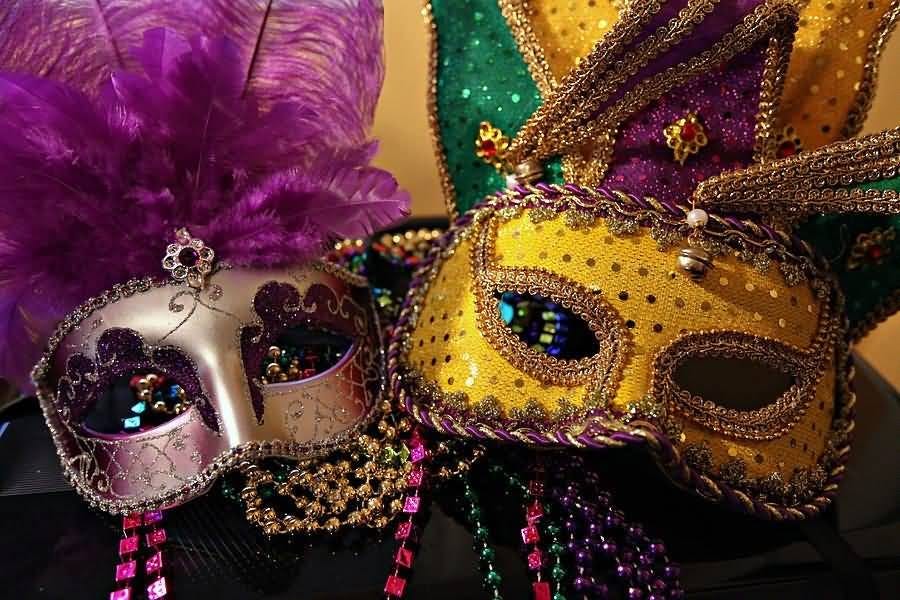
Since then, krewes have remained a fixture of the Carnival scene throughout Louisiana. Other lasting customs include throwing beads and other trinkets, wearing masks, decorating floats, and eating King Cake.
Rex, one of the oldest Mardi Gras krewes, has been participating in parades since 1872 and established purple, gold, and green as the iconic Mardi Gras colors.
Louisiana is the only state in which Mardi Gras is a legal holiday. However, elaborate carnival festivities draw crowds in other parts of the United States during the Mardi Gras season as well, including Alabama and Mississippi. Each region has its own events and traditions.
From King Cake to Zulu Coconuts: The History of 6 Mardi Gras Traditions
1. Krewes
Within two decades after the French explorer Bienville LeMoyne founded New Orleans in 1718, the city’s annual celebrations of Carnival had become an annual event, complete with masked balls and other festivities. Parades commemorating Mardi Gras (the last day of Carnival and the day before Ash Wednesday, the first day of Lent) officially began in 1838. By 1857, however, New Orleans’ Mardi Gras celebrations had become so marred by drunkenness and violence that city officials were about to do away with them. Instead, several members of a group known as the Cowbellion de Rakin Society, which had held an annual New Year’s Eve parade since the 1830s, stepped forward. They proposed forming a new private club that would stage its own Mardi Gras parade as an orderly alternative to the chaos that currently existed. They called their new organization the Mystick Krewe of Comus (the Greek god of revelry). Today, more than 70 krewes parade through New Orleans on Mardi Gras, after celebrating the two weeks of Carnival with invitation-only balls and supper dances.
2. Rex, King of Carnival
Among the most famous krewes is the Krewe of Rex, founded in 1872. That year, the Grand Duke Alexis Romanov Alexandrovitch, brother to the heir apparent to the Russian throne, accepted an invitation to attend Mardi Gras festivities in New Orleans. Prominent city businessmen organized the visit as a way of attracting tourism and business to the city after the Civil War. Forming a new krewe of prominent citizens, they designated the krewe’s leader for the year as Rex (Latin for king). Officially called the School of Design, the krewe is more commonly known as the Krewe of Rex. Every year since, a prominent person has been chosen to be Rex, that year’s King of Carnival (the Grand Duke was the first one) and given the symbolic key to the city by the mayor.
3. Bead throwing
The true meaning of the famous Mardi Gras beads begins with their traditional colors, which we also owe to the Russian Grand Duke Alexis. During his visit in 1872, the newly founded Krewe of Rex chose the colors of the duke’s royal house for the beads that krewe members would throw from their parade float into the crowds of Mardi Gras revelers. Later, they assigned meaning to each color: Purple stood for justice, green for faith and gold for power. The idea was to toss the beads to those in the crowd who exhibited these traits; the people who caught them were said to get good luck for the coming year. Though the beads were originally glass, nowadays they’re made of plastic, and are one of the most popular Mardi Gras traditions.
4. Zulu coconuts
Also among the most coveted of Mardi Gras parade “throws” are Zulu coconuts, the round, painted, glittery orbs thrown out by members of the Zulu Social Aid and Pleasure Club. One of the oldest traditionally African-American krewes, Zulu held its first parade in 1909. The very next year, as the historical record shows, they began tossing coconuts to members of the crowd. Originally, the coconuts were left in their natural brown, hairy state, but a tradition soon began of painting them and decorating them with glitter. Nowadays, Zulu coconuts are handed into the crowd rather than thrown, to avoid injuries (and lawsuits).
5. Flambeaux
The blazing torches lighting the way for parade-goers during nighttime Mardi Gras festivities are called flambeaux (French for torch), and they date back to a custom established by the original Mardi Gras krewe, Comus. In the mid-19th century, torches were a necessity due to the lack of sufficient street lighting. The original flambeaux carriers were slaves and free men of color, and their torches were probably made with shredded rope soaked in pitch and set ablaze. Crowds lining the parade route would toss coins to the flambeaux carriers, a tradition that continues today. Over the years, however, Mardi Gras flambeaux have evolved into a kind of performance art, as the robe-wearing carriers twirl and dance with their torches, now much lighter and fueled by butane or kerosene.
6. King cake
The story behind one of Mardi Gras’ most popular foods dates back to the Middle Ages. That’s when people began celebrating the tradition of the Three Kings, who brought gifts to the baby Jesus on Twelfth Night (the end of Christmas and the beginning of Epiphany). Along with giving special gifts to children, the custom arose to eat a special kind of cake for the occasion. King cakes are now consumed throughout the season, beginning on Twelfth Night (January 6) and ending on Mardi Gras. Originally just a simple ring of dough, the king cake took different forms over the years; today, the most popular form is a braided Danish pastry laced with cinnamon and iced in the Mardi Gras colors of purple, green and gold. According to a tradition launched in the 1940s by Donald Entringer, who owned one of New Orleans’ largest commercial bakeries, a tiny baby figurine (meant to represent Jesus) was baked into each king cake. The baby is usually made of plastic, but in past years was sometimes porcelain or even gold. According to custom, whoever gets the baby in his or her slice must buy the next cake or host the next party. As with Zulu coconuts, however, fear of lawsuits has led to changes in the king cake tradition: Many bakeries have recently stopped baking baby figurines into their cakes, instead choosing to package them separately for customers to insert themselves.
Mardi Gras Around the World
Across the globe, pre-Lenten festivals continue to take place in many countries with significant Roman Catholic populations.
Brazil’s weeklong Carnival festivities feature a vibrant amalgam of European, African, and native traditions. In Canada, Quebec City hosts the giant Quebec Winter Carnival. In Italy, tourists flock to Venice’s Carnevale, which dates back to the 13th century and is famous for its masquerade balls.
Known as Karneval, Fastnacht, or Fasching, the German celebration includes parades, costume balls, and a tradition that empowers women to cut off men’s ties. For Denmark’s Fastevlan, children dress up and similarly gather candy to Halloween—although the parallel ends when they ritually flog their parents on Easter Sunday morning.
CREDIT: HISTORY.COM