Friday the 13th: Where does it come from and why do we still care?
It makes good fodder for films, but where did this superstition come from?
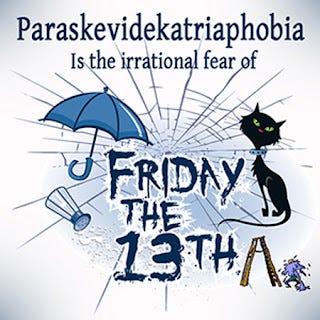
Today is Friday the 13th, and many people will be nervously watching the skies for sudden lightning strikes or falling anvils. But where does our superstition surrounding this day, known as paraskevidekatriaphobia, originate from?
And why is there so much apprehension about the number 13? This fear, called Triskaidekaphobia, is not just of concern to some people a few days of the year – it drives them to avoid using 13 as much as possible in daily life.
Friday the 13th in history and fiction
Though folklorists claim there is no written evidence of this superstition before the nineteenth century, the date has long been associated with notorious events in history and religion.
Unlucky 13?
The origins of Triskaidekaphobia – the fear of the number 13 – could be traced back to the 19th-century belief that Judas Iscariot sat in the 13th place at Jesus’s table at the Last Supper.
According to Catholic belief, one of the most significant events in their religion - the crucifixion of Jesus Christ - took place on a Friday the 13th.
By contrast, the number 13 is considered a lucky number in the Jewish faith. A boy becomes a man at age 13 upon completion of his Bar Mitzvah.
Geoffrey Chaucer also referred to the apparent unluckiness of the day, recording in his Canterbury Tales that it was bad luck to start a journey or a project on a Friday.
One of the most popularized myths attempting to explain the origin of the Friday 13 superstition stems from events on Friday, 13 October 1307, when hundreds of Knights Templar were arrested and burnt across France.
This myth caught the public’s attention after it was used by Dan Brown, among other historical fiction writers, and has been peddled endlessly by conspiracy theorists linking the Knights Templar to everything from Freemasonry to the Holy Grail.
The Thirteen Club first met on 13 September 1881 (a Wednesday) and determined to actively flout all established ‘superstitions’ they knew about.
With this in mind, the group of 13 would meet on the 13th of each month, sit 13 at a table, break mirrors, spill salt with abandon, and walk under ladders – all while carefully recording how many members died.
Over the years, the group grew to roughly 400 members – including many US presidents – but the group’s notoriety merely added to the date’s significance in the public psyche.
Then, in 1907, eccentric stockbroker Thomas Lawson published a book called Friday the Thirteenth. It detailed an evil business’s attempts to crash the stock market on the unluckiest day of the year. The book was a sell-out and in 1916 was made into a feature-length film.
Finally, the myth got the first seal of Hollywood in 1980 when Paramount Pictures released Friday the 13th. Fridays would not be the same again after Jason proceeded to slash his way across a summer camp and US box offices.
The ‘statistics’ of Friday 13th
There have been various studies released over the years that either prove or disprove the Friday 13 myth.
In 1993, a British Medical Journal study claimed there was a “significant” increase in incidences on a Friday the 13th, but the author of the study later confessed it was “a bit of fun” as traditional in the Christmas edition.
Meanwhile, Dutch researchers found you were less likely to be injured on Friday the 13th. The study hypothesized that people were more careful on the day as a result of the superstition.
Not Friday the 13th but Tuesday the 17th?
As it turns out, paraskevidekatriaphobia is mostly an American and English fear.
Italians used to be far more concerned about Friday the 17th, although, with the Americanization of the country, this has largely shifted to the 13th for younger generations.
In Spanish-speaking countries, it is Tuesdays, not Fridays, that hold superstitious omens. Their belief is also held by the Greeks, who consider Tuesdays as dominated by the influence of Ares (the God of War).
CREDIT: Independent News- Weird News
Rose Troup Buchanan
Will Worley