
The High Jewish Holiday Season
The ten-day High Holiday season begins at sundown on Sunday, September 12, 2026, for Jews around the world. The season begins with Rosh Hashanah, the New Year on the Jewish Calendar, and ends with Yom Kippur, the Day of Atonement, when Jews ask God to forgive their sins for the past year.
Rosh Hashanah is the time when the Book of Life is unsealed for ten days, and by Jewish law, it is when every Jew’s fate for the coming year is determined. The holiday is celebrated for two days. As such, Jews should not say “Happy New Year,” any more than one would wish a Roman Catholic a “Happy Good Friday.”
This year Rosh Hashanah falls on Tishrei, the seventh month of the Jewish calendar, and the new year is 5783. Huh? Wait a minute. What happened to 2022? Did we time travel or something? How did we jump ahead to the future? Of course, we didn’t. The Jewish religion and its calendar preceded the Roman Empire and its calendar. For everyday practical purposes, Jews go by the Roman calendar like everyone else. But for religious purposes, Jews go by the Jewish calendar.
According to Hebrew time reckoning, we are now in the 6th millennium. The Hebrew year count starts in the year 3761 BCE, which the 12th-century Jewish philosopher Maimonides established as the biblical Date of Creation.
Years in the Jewish calendar are designated AM to identify them as part of the Anno Mundi epoch, indicating the age of the world according to the Bible. For example, the beginning of the year 2022 in the Gregorian calendar converts to the year AM 5782 in the Jewish calendar.
History and Background of the Jewish Calendar:
The Jewish calendar is based on time-reckoning efforts dating back to ancient times. Both Israelite and Babylonian influences played an important role in its development. According to the account of Persian astronomer al-Khwarizmi (c. 780 – 850 CE), most of the features of its modern-day version were in place by the 9th century CE.
In parallel with the modern Islamic calendar, the timing of the months in the early forms of the Jewish calendar depended on actual sightings of the Crescent Moon. However, this practice was gradually changed, and by 1178 CE the calculation of the beginning of a new calendar month had been fully replaced by the mathematical approximation of the moment the Crescent Moon begins to appear (Molad) rather than actual sightings.
How Rosh Hashanah Is Celebrated:
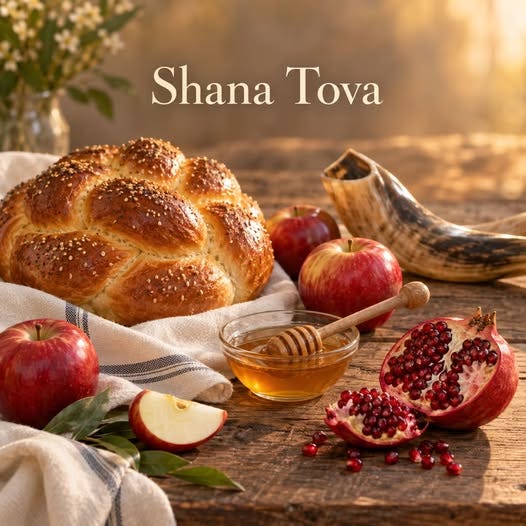
Hearing the sounding of the ram’s horn (shofar) on both mornings (except Shabbat)
Lighting candles each evening for two evenings.
Eating festive meals with sweet delicacies during the night and day, which include:
· Kiddush/prayer over wine or grape juice
· Round, raisin challah bread dipped in honey
· Apples dipped in honey (on the first night)
· The head of a fish, pomegranates, and other foods symbolize our wishes for the coming year (on the first night)
· A new fruit (on the second night)
Performing Tashlich, a brief prayer said at a body of fresh water
Attending services in the synagogue
Desisting from creative work
CREDIT: CHABAD
You had me at raisin challah bread dipped in honey. 😊 I love your little tidbits about Jewish life.