
Book Banter
Susie Black’s Newsletter
Edition 8, October 2026
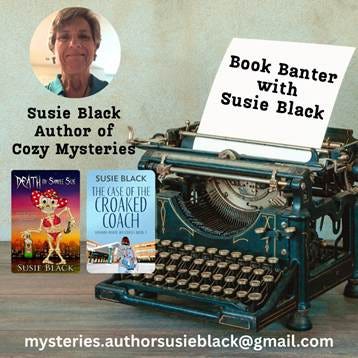
Hello! I’m Susie Black. I write humorous cozy mysteries. Thanks for taking a peek at my monthly newsletter. I discuss my writing, books, and anything else that piques my interest.
In this edition:
What I’m Thinking About
What I’m Reading
What I’m Writing
What I’m Thinking About:
The Interesting History of the Expression “Spill the Beans.”
Even the most skilled wordsmith will admit to having consulted a dictionary or thesaurus for a more descriptive word at one time or another. The most experienced writers have been tempted to reach into that bag of clichés and phrases and liberally splatter our manuscripts with them. But did you ever stop to wonder how and when those clichés and phrases came to be? As a cozy mystery author whose stories include suspects or witnesses who inadvertently or purposely reveal critical information, I recently wondered about the origin of one phrase in particular: Spill the Beans.
Here is the short history of the phrase:
Ancient Greece
· There are a few possible explanations for where “spill the beans” came from. One explanation dates back to ancient Greece, when people used beans to vote anonymously. White beans for positive votes, and black beans or other dark-colored beans for negative votes. These votes were cast in secret, so if someone knocked over the beans in the jar—whether accidentally or intentionally—they “spilled the beans” and revealed the vote results.
· Modern times
· Having the expression date back to ancient Greece is nice in theory, but where does it show up in modern times? Let’s look at the meaning behind the word “spill.” You know the word from when you accidentally spill something on the floor and from the saying “no use crying over spilled milk.”
· But since the 16th century, when used as a verb, “spill” has also meant “divulge” or “let out.” One instance of this use of “spill” in the 1500s is from Edward Hellowes’ Guevara’s Familiar Epistles. The passage reads: “Although it be a shame to spill it, I will not leave to say that which… his friends haue said vnto me.”
· There may be a darker interpretation of the “let out” meaning of the word “spill.” In the 14th century, “kill” was another word used for “spill.” So, “spill blood” was in use during that period.
· But what connects the dots between “spill” and “beans”? According to the Phrase Finder, an early example of “spill the beans” has been found in the United States from The Stevens Point Journal in June 1908:
· “Tawney, when he came to congress, wasn’t welcomed within the big tent. He had to wait on the outside. Then the blacksmith [Jim Tawney] got busy. He just walked off the reservation, taking enough insurgent Republicans with him to spill the beans for the big five.”
· “Spill the beans” in this instance was akin to “upset the applecart” or “spoil the beans,” a nod to the voting system in ancient Greece. Similarly, according to the Phrase Finder, another instance of “spill the beans” in the 20th century was found in October 1911 in The Van Wert Daily Bulletin: “Finally Secretary Fisher, of the President’s cabinet, who had just returned from a trip to Alaska, was called by Governor Stubbs to the front, and proceeded, as one writer says, to ‘spill the beans’.” Shortly thereafter, the phrase “spill the beans” came to mean “upset a previously stable situation by talking out of turn.”
CREDIT: READERS DIGEST Madeline Wahl May 26, 2020
What I’m Reading:
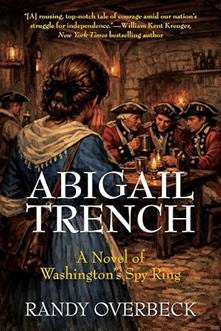
I just finished reading Abigail Trench, an historical thriller written by Randy Overbeck.
Here’s a blurb to whet your appetite:
“A vivid, propulsive Revolutionary-era thriller with the spy-craft verve of the streaming hit TURN: Washington’s Spies and the electricity of 1776’s New York that Hamilton lovers will recognize, this story is inspired by the lone female operative in Washington’s spy ring. In occupied New York, a schoolteacher with everything to lose turns information into a weapon, threading between Redcoats and rebels as plots against Washington gather steam. After rogue Redcoats assault her and strip her family’s Long Island farm, Abigail Trench fights to survive in New York City—tutoring in a high-ranking British officer’s Water Street household by day, navigating taverns, informants, and soldiers by night. Through Abigail’s keen eyes—and a counter-narrative following a principled British major—the novel renders the moral gray zones of occupation with gritty intimacy. As rumors swirl of a strike at General Washington, Abigail’s vantage inside upper-crust parlors and rough waterfront rooms makes her an ideal courier—and a target. This historical thriller delivers high tension, textured world-building, and a captivating heroine who puts it all on the line for freedom.
Here is my review:
Leave it to clever Randy Overbeck to turn an historical event into a character and give it a personality of its own.
Abigail Trench is a fictional epic masterpiece inspired by the United States Revolutionary War. This historical saga focuses on a colonial schoolteacher in New York who tutors the children of a British army officer and finds herself perfectly positioned to spy for the Continental Army.
Overbeck has written a cleverly plotted allegory of good versus evil. The author wove a timely tale that unflinchingly spotlights the incredible cruelty of the British Army, the hardships colonial families faced, and the gut-wrenching, sometimes life-and-death decisions they were forced to make to give their children a chance at a better life.
The author’s descriptions paint a vivid picture of the conflict between the Colonists and Loyalists so detailed that readers can hear the cries of the dying colonial inmates on a prisoner ship, smell the acrid odor of death permeating the ship’s bowels, and feel the deadly snap of the rope tightening around his neck as a colonist is hanged by the British Army.
The story moves with the whiplash of an emotional rollercoaster ride through an intricate plot. The cast of flawed but believable characters drives a complicated story that grabs readers by the throat and never lets go, while rooting for the protagonists to the last page. Overbeck cranks up the conflict with a backstory that keeps readers turning pages to see how it turns out.
The story deftly weaves a taut plot driven by love, loss, trust, family ties, and the inner strength one must summon to face adversity head-on rather than look away. Part romance, part historical saga, part redemption with a second chance at life and love, Abigail Trench will capture the imagination of readers who enjoy a love story fueled by a mixture of courage and conflict, and appreciate that when one door closes, another one opens, but only if you dare to step across the threshold.
https://www.amazon.com/Abigail-Trench-Novel-Washingtons-Ring-ebook/dp/B0G95HW2PN/ref=sr_1_1?c
What I’m Writing:
The response to the debut title of The Sunny Knight Mystery Series was absolutely fantastic. The Forecast is…Murder! has been such a hit with readers that I’ve already written the second book in the series. The book is slated for release this November. Last month, I whetted your appetite with a blurb from The Forecast is…Monsoon!
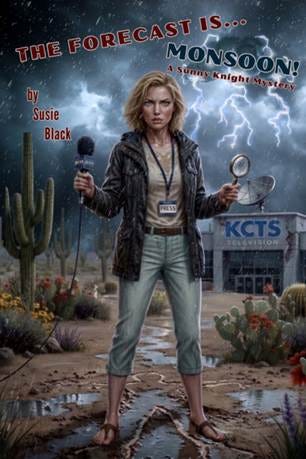
Here is an excerpt from the first chapter:
Minutes before going on the air, KCTS TV News Producer Big Tommy Hernandez, cameraman Allen Forsythe, and I braved the swirling climate chaos resulting in uprooted trees, washed-out roads, and flooded streets so I could give an eyewitness report on the mid-July monsoon that dropped a non-stop deluge of rain on Imperial County, California, for the past four hours.
I pushed the studio exit door, but with the force of a fifty-five-mile-an-hour monsoonal wind blowing against it, it was as difficult as moving an eighteen-wheeler. Big Tommy waved his ham-hock-sized hand for me to move aside. A curtain of rain drenched us as Tommy gave the door a mighty shove, and it flew open.
Before I strapped my rain hat under my chin, the howling wind blew the pouring rain sideways. It whipped my bangs into my eyes, and I felt my way around the sodden set like a blind guy playing hide-and-seek, trying to find my mark. I imitated my dog, Angus, after a bath, in an ill-conceived attempt to shake off the rivulets of rain sluicing down my face.
Big Tommy bent in half and pointlessly mopped the rain off his face using his soaked-to-the-skin shirt sleeve. He pointed at the monitor, picturing Evening News anchor and legend-in-his-own-mind Patrick Sterling’s kisser on the screen, and growled, “I suppose it was his brilliant idea for a field report in the middle of a monsoon?”
I shook my head, and a spray of water flew off my hat and hit Big Tommy in the face. “Nope. As much as I want to blame Patrick, thank Mrs. McClintock for this one.”
Big Tommy’s jaw dropped. “The boss dreamed up this stupid stunt?” He waved his arm at the relentless rain. “Get this take done in one. If we’re outside much longer, we’ll be building an ark.”
Big Tommy looked over to Allen. “Are you all set up?”
Allen gave Tommy the thumbs-up sign.
While Tommy lit the portable spotlights and tossed a weighted shroud over Allen and the camera, I found my mark. I dug in my heels and prayed I wasn’t blown into a sandy sea of shoe-sucking mud.
I watched the monitor as Patrick feather-fingered his not-a-strand-out-of-place helmet of gelled, stiff hair and looked into the camera. The camera followed the strawberry-blond, blue-eyed self-proclaimed heartthrob’s hand as he waved to a large map of Imperial County to the left of the news desk.
“Now it’s time for our newest addition to the KCTS family, our very own ray of sunshine, Sunny Knight, reporting tonight from outside our studio, to bring you the latest weather forecast.” He licked his lips and purred like a well-fed cat. “Sunny, I can’t wait to hear how sunny tomorrow will be.”
Apparently, the MeToo Movement didn’t make it to this backwater burg. If Patrick took his eyes off himself for even a moment and saw the buckets of rain falling, he’d realize the forecast wouldn’t be sunny... And give the arrogant, self-absorbed fool way too much credit for brains? Nah.
Big Tommy rolled his eyes, pointed a sausage-sized index finger at the monitor, and counted us down. “In five-four-three-two, and we are live on the air.”
I opened my oversized umbrella, shielded the microphone from the rain, and smiled into the camera. “Good evening, ladies and gentlemen. If you haven’t been outside the last few hours, you can probably guess by the howling wind and drenching rain outside our studio that today’s forecast will not be my usual sunny one.
“As some of you know, I’m new to the desert. I was prepared for the six-month-long blast-furnace temperatures and bone-dry humidity. But the last forecast I ever imagined reporting on was a monsoonal downpour. And finding an available rain slicker or an umbrella anywhere in Imperial or Riverside Counties proved impossible.” I fingered the front of my rain slicker and laughed. “My sister shipped my rain gear from New Jersey.”
Patrick chimed in, “So, what’s a monsoonal?”
I pointed to several palm trees bent in half by the wind. “Well, Patrick, and all of our viewers at home, according to the National Oceanic and Atmospheric Administration, a monsoon is a major seasonal weather shift when the winds reverse direction and bring heavy moisture into the region.”
Patrick asked, “What makes the winds shift?”
The Wind Fairy puffs up her cheeks and blows really hard.
Lucky for Patrick, I needed the job, so I bit back my snappy comeback and played nicely in the sandbox.
“An excellent question, Patrick. They shift because land and water temperatures change seasonally. At the start of summer, land heats up faster than bodies of water. Monsoon winds always blow from cold to warm. In summer, those conditions reverse the wind direction of warm air rising from the land. As the land warms in northwestern Mexico, Arizona, California, and New Mexico, the winds change direction. They carry moist air from the Pacific Ocean and the Gulf of California into the region. This leads to thunderstorms and rainfall. Rising temperatures, moisture in the air, and instability aloft produce thunderstorms.”
Patrick asked, “So, Sunny, how long a season are we talking about?”
“The North American Monsoon season begins in June and ends in September.”
Patrick asked, “How strong are these winds?”
“The wind gusts sometimes reach 100 mph. Sustained winds of 45 to 65 mph are common.”
Patrick squealed, “Yikes! Thousands of date palms in this county play a major role in our local economy. It’d be a disaster if entire date palm groves got uprooted. How do date palms fare in monsoonal conditions?”
“I consulted several date palm farmers and asked them about that issue. Mother Nature amply prepared date palm trees for high winds. The incredibly strong trunks are thicker at the base and anchor the trees into the ground. The trunk narrows as it grows higher. The thinner part of the trunk is strong but pliable. It bends with the wind. The fronds are compound leaves. The strips of green are actually leaflets of the frond that fold into themselves.” I moved my right-hand fingers in and out. “It’s similar to opening and closing a fan. This creates an open canopy, allowing wind to blow through. Unlike other trees, most date palms survive high wind conditions.”
A huge gust of wind hit me broadside, and I pinwheeled my arms to keep my balance. Big Tommy grabbed me by the collar of my rain slicker from behind as the gust shifted, lifting me off the ground. He set me down and kept his hand on the back of my slicker’s belt as I teetered, seconds from falling on my ass. “A-as y-you c-can imagine, the winds are creating havoc all over Imperial County. CalTrans has announced numerous flooded streets and several washed-out roads.”
Patrick whined like a cranky toddler. “How long is this monsoon gonna last? I’ve got a tee time of seven tomorrow morning.”
I shook my head. “At the rate this rain is falling, by seven tomorrow morning, you’d need waders instead of golf cleats. Based on the US Weather Service forecast, the only eighteen holes you’ll see tomorrow will be on the Golf Channel. The forecast for the next twelve hours is winds gusting as high as one hundred miles per hour, sustained winds in the mid-thirty-mile-an-hour range, accompanied by torrential rains.”
Mother Nature stuck her two cents in and punctuated my forecast by dropping a huge wall of rain. I shook my head to clear the water from my blurred eyes and hoped I was looking straight into the camera.
“Our station will provide up-to-the-minute storm information. The California Highway Patrol recommends that Imperial County residents avoid going out unless necessary for the next twelve hours. Listen to the experts and don’t take any unnecessary chances.” I shook off another sheet of pelting rain and smiled into the camera. “This is Sunny Knight wishing you all a safe and dry evening.”
Big Tommy counted us down and growled, “They don’t pay me enough for this crap.” Then the three of us grabbed our equipment and made a mad dash for the studio door.
Maybe if I asked her sweetly, Annabelle from the wardrobe department would wring me out like a sponge.
Until next month, happy reading.
Thank you very much for the history behind spill the beans. I really like tidbits like that.